You use machine learning dozens of times a day without realising it. This is what’s actually happening under the hood — no equations, no jargon, just the real idea.
Before We Start — A Promise
This article contains:
- ✅ Real explanations
- ✅ Everyday examples you already know
- ✅ The actual intuition behind how it works
- ❌ No Greek letters
- ❌ No matrices
- ❌ No prerequisites whatsoever
If you’ve ever Googled “what is machine learning” and ended up more confused than when you started — this one is for you.
So What Actually Is Machine Learning?
Here’s the one-sentence version:
Machine learning is teaching a computer to find patterns in data, so it can make decisions without being explicitly told the rules.
That’s it. Everything else is just detail.
Let’s unpack that with something you do every single day.
The Email Spam Example
Think about your email inbox. Somewhere in there is a spam folder. Emails from Nigerian princes, fake prize notifications, and suspicious links — they all get filtered out before you ever see them.
How does your email provider know what’s spam?
Nobody sat down and wrote a list of rules like:
- “If the subject line contains the word ‘FREE’ in capital letters → spam”
- “If the sender domain ends in .xyz → spam”
- “If the email body has more than 3 exclamation marks → spam”
Well… actually, early spam filters did exactly that. And spammers immediately learned to work around every single rule.
So engineers tried a different approach. Instead of writing the rules themselves, they said:
“Here are 100,000 emails. These 50,000 are spam. These 50,000 are not. Figure out the pattern yourself.”
And the machine did. It found patterns humans never would have written down — subtle combinations of word choice, sending time, formatting quirks, link structures. Things too complex and numerous to code by hand.
That process — showing a machine examples and letting it find the rules — is machine learning.
The Three Words That Actually Matter
When people talk about machine learning, three terms come up constantly. Here’s what they actually mean in plain English:
1. Training
This is the learning phase. You give the machine a large set of examples — emails, photos, transactions, whatever — and it studies them to find patterns.
Think of it like showing a child thousands of pictures of cats and dogs and saying “this is a cat, this is a dog” over and over. Eventually they learn to tell the difference, even with a photo they’ve never seen.
2. Model
The “model” is just the result of training. It’s the set of patterns the machine discovered, saved in a format it can use to make future decisions.
Think of it as the machine’s memory of everything it learned.
3. Prediction
Once trained, the model looks at new data it’s never seen before and makes a guess. A new email arrives — is it spam? A new photo — is it a cat or a dog? A customer adds something to their cart — will they complete the purchase?
That guess is called a prediction.
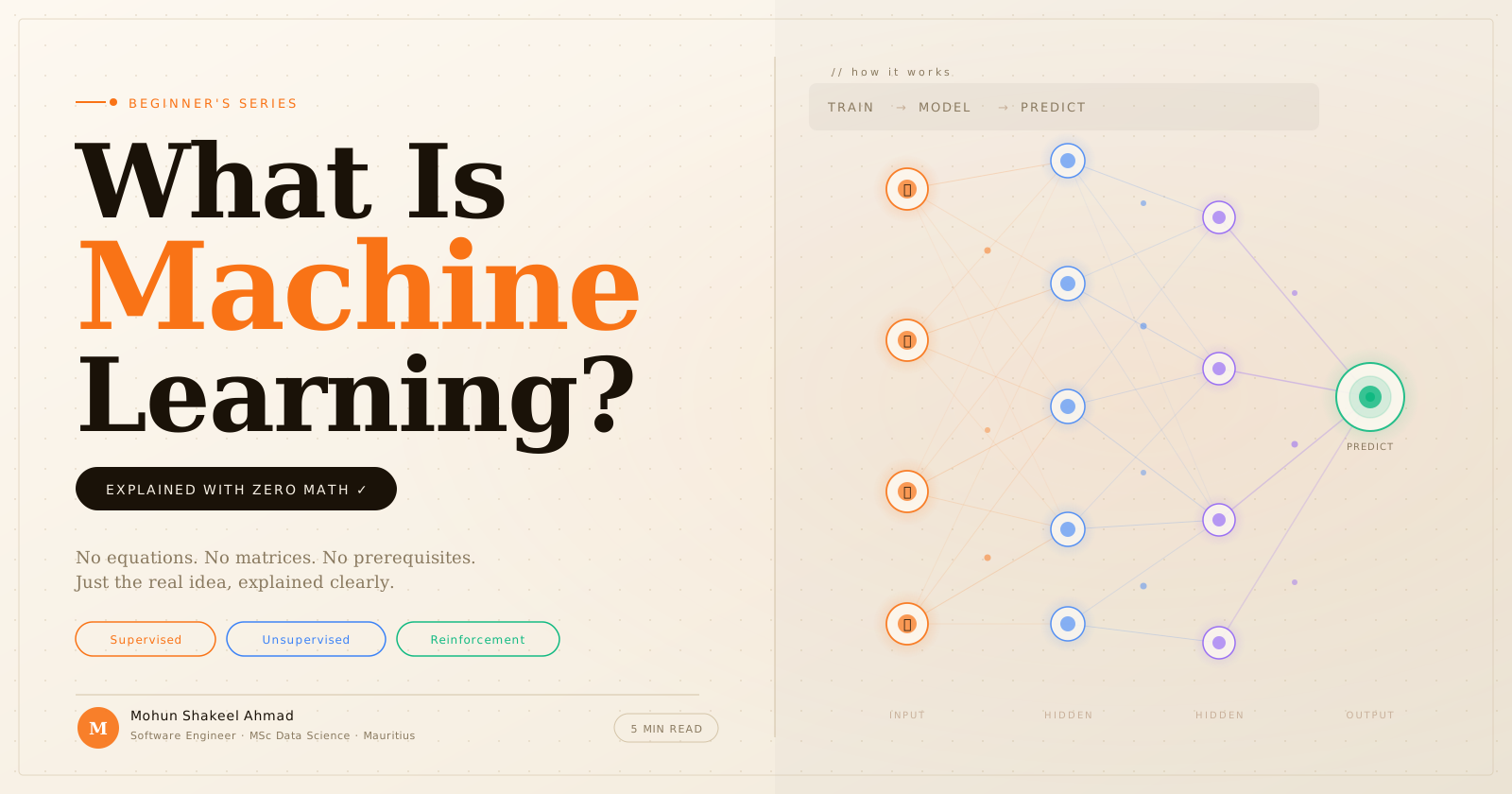
Train → Model → Predict. That’s the whole loop.
Three Types of Machine Learning (With Zero Math)
There are three main flavours of machine learning. Here’s how to think about each one:
🏫 Supervised Learning — Learning With a Teacher
You give the machine labelled examples. “This email is spam. This one isn’t. This photo is a cat. This one is a dog.”
The machine learns from the correct answers you provide, like a student studying with an answer key.
Real examples you use every day:
- Email spam filters
- Face recognition on your phone
- Credit card fraud detection
- Autocorrect on your keyboard
🔍 Unsupervised Learning — Finding Hidden Groups
You give the machine data, but no labels. No right or wrong answers. You just say: “Find something interesting.”
The machine groups similar things together on its own. It discovers structure you didn’t know was there.
Real examples:
- Spotify grouping listeners by taste to power Discover Weekly
- Your bank identifying unusual transaction clusters
- Netflix grouping users with similar viewing habits
- News apps clustering similar stories together
🎮 Reinforcement Learning — Learning by Trial and Error
The machine tries something. If it goes well, it gets a reward. If it goes badly, it gets a penalty. Over time it figures out what works.
This is exactly how you learned to ride a bike. Nobody gave you a manual. You fell, adjusted, tried again, and eventually found the balance point.
Real examples:
- AlphaGo (the AI that beat the world’s best Go player)
- Self-driving car systems learning to navigate
- AI that learns to play video games from scratch
- Robots learning to walk
The Spotify Example — Putting It All Together
Let’s walk through a real-world example from start to finish.
Every week, Spotify creates a personalised playlist for you called Discover Weekly. Songs you’ve never heard, but somehow always feel right. How?
Step 1 — Data collection Spotify has data on hundreds of millions of users. Every song you’ve ever played, skipped, replayed, added to a playlist, or listened to at 2am.
Step 2 — Finding patterns (unsupervised learning) It groups users who listen to similar things. You and thousands of people you’ve never met have suspiciously similar taste in music. Spotify finds that overlap.
Step 3 — Making predictions (supervised learning) Based on what similar users loved that you haven’t heard yet, Spotify predicts which songs you’re likely to enjoy. It’s essentially saying: “People who like what you like, also loved these tracks.”
Step 4 — Feedback loop (reinforcement learning) You listen. You skip. You replay. You add to your playlist. Every action tells Spotify whether its prediction was right or wrong — and the model updates accordingly.
That’s machine learning working in layers, in real time, at scale. And you never noticed the math.
What Machine Learning Is NOT
A few myths worth clearing up:
❌ “Machine learning means the computer is thinking” No. It’s finding statistical patterns in data. Very sophisticated pattern matching — not consciousness, not understanding, not common sense.
❌ “You need to be a mathematician to work with it” The researchers who build ML algorithms from scratch? Yes, they need serious math. But applying existing models to real problems? That’s much more accessible than people think.
❌ “More data always means better results” Bad data in, bad results out. A million rows of messy, inaccurate data will produce a worse model than ten thousand rows of clean, well-labelled data. Quality beats quantity.
❌ “Machine learning can do anything” It’s exceptional at finding patterns. It’s terrible at reasoning, understanding context, and anything that requires genuine judgment. It’s a powerful tool with very real limits.
Why Should You Care?
Whether you’re a developer, a business analyst, a marketer, a student, or someone who just uses a smartphone — machine learning is already making decisions that affect your life.
Which job listings you see. Which loan applications get approved. Which medical scans get flagged. Which content fills your feed.
Understanding what it is — and what it isn’t — makes you a more informed person in a world where these systems are everywhere.
And if you’re thinking about a career in tech, data science, or analytics? This is the foundation everything else is built on.
What’s Next?
If this clicked for you, here’s a natural reading order to go deeper:
- How AI Image Generators Work — one modern model, explained without the equations
- Implementing K-Means Clustering From Scratch — unsupervised learning, built step by step
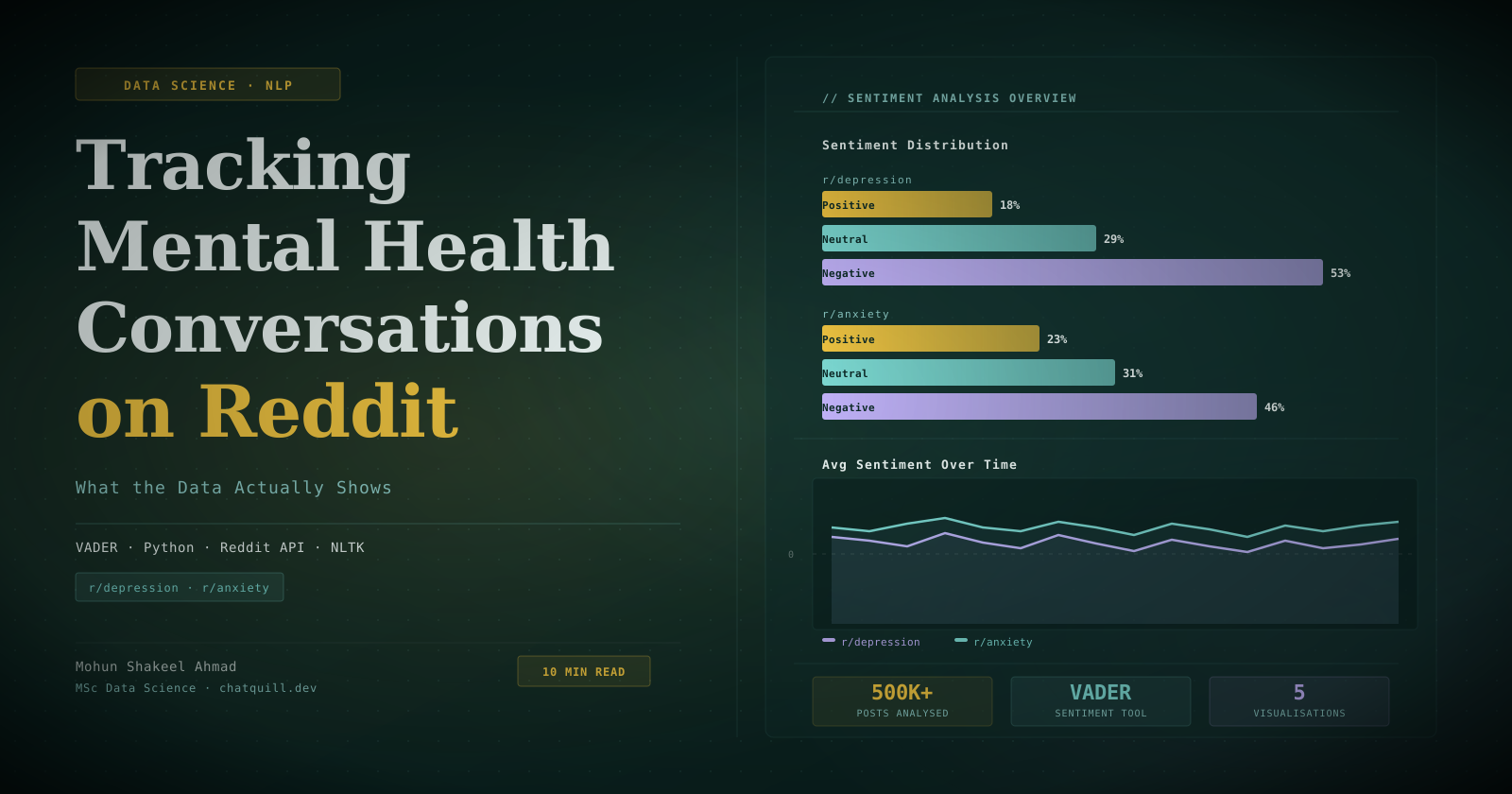
- Tracking Mental Health Conversations on Reddit — a full analysis on real data
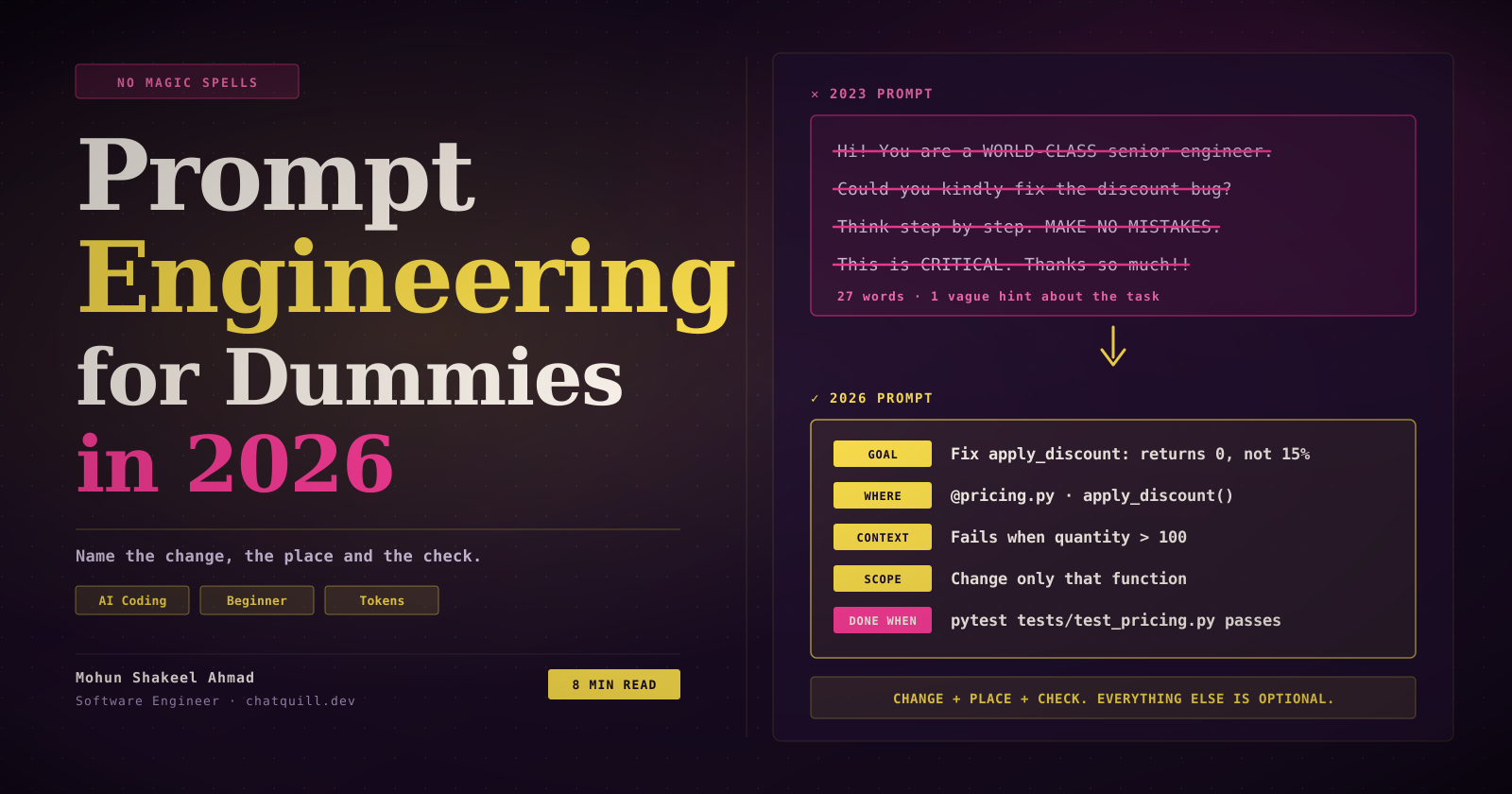
- Prompt Engineering for Dummies in 2026 — getting useful work out of AI tools
The first one needs no math at all. The next two add a little Python.
The One-Line Summary
Machine learning is showing a computer thousands of examples and letting it figure out the rules — so it can apply those rules to new situations it’s never seen before.
Everything else is just building on that idea.
Mohun Shakeel Ahmad — Software Engineer at Spoon Consulting / SharinPix. MSc Data Science (Distinction), Sunway University. BSc Computer Science (First Class Honours), University of Mauritius. Writing about tech, data and software for humans.