AI Code Review: Is It Ready to Replace Your Senior Dev?
I’ve been on both sides of the PR. Here’s what four years of shipping code taught me about trusting machines with the review queue.
Quick Stats Before We Dive In
| Metric | AI Review |
|---|---|
| 🟢 Surface-level issues caught | ~87% |
| 🔴 Context-aware feedback | ~23% |
| 🔵 Availability | 24/7, instant |
The Setup
Let me paint you a familiar picture. It’s Thursday afternoon. You’ve spent three days building a feature — Rails backend, TypeScript on the frontend, Redis for the queue. The PR is ready. You need a review before the Friday deploy window.
Your senior dev is in back-to-back meetings until EOD. So you do what we all do now — you paste the diff into an AI tool and ask it to take a look. And it comes back with fifteen comments in under ten seconds.
That’s where the interesting question starts. How many of those fifteen comments can you actually trust?
What AI Gets Genuinely Right
I want to be fair here — in my day-to-day at SharinPix, AI-assisted review has caught real issues. Things I might have skimmed past at 5pm on a Friday.
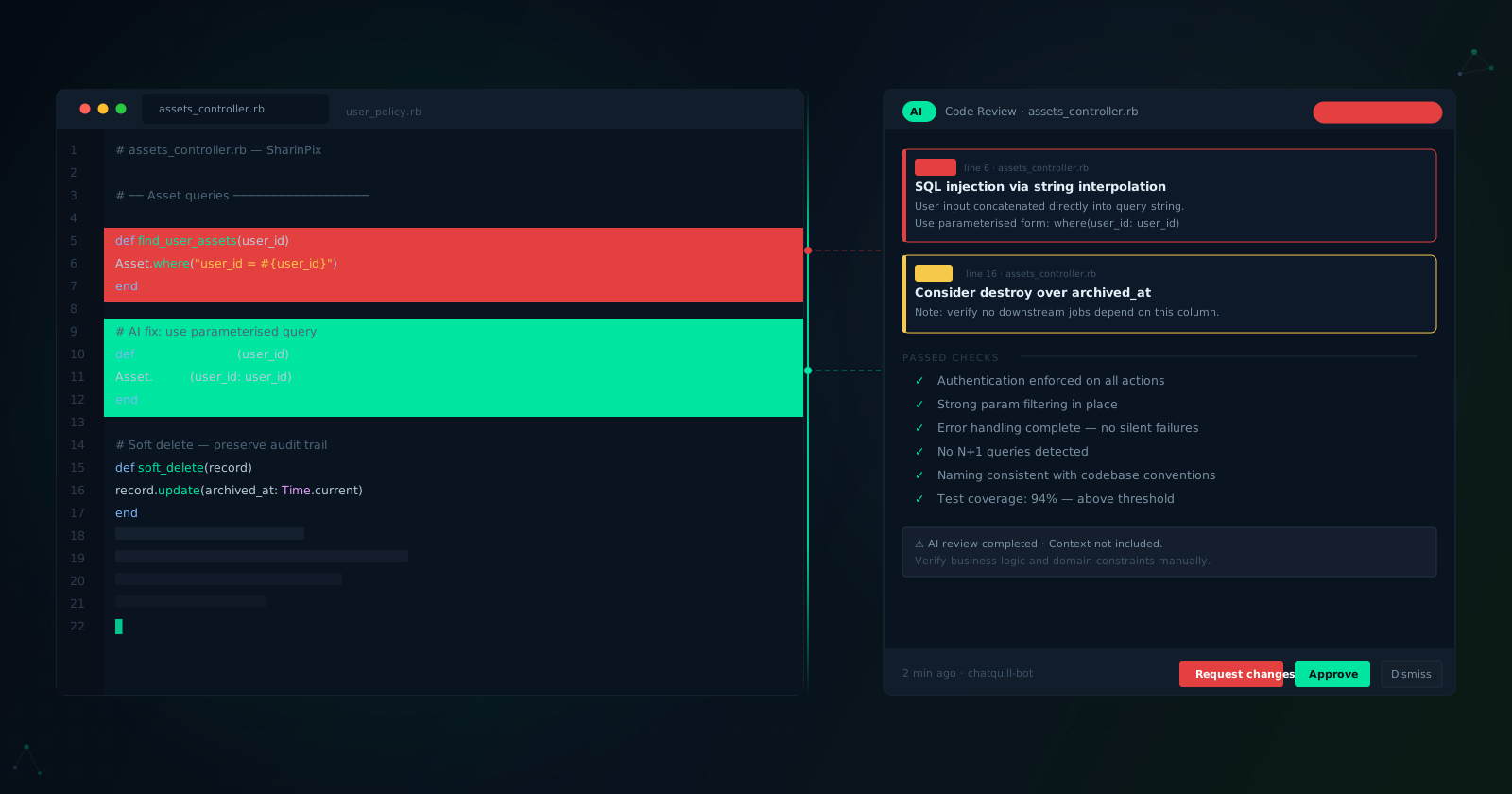
Take this classic example:
# ❌ Before: what I wrote
def find_user_assets(user_id)
  Asset.where("user_id = #{user_id}")  # SQL injection waiting to happen
end

# ✅ After: AI flagged it immediately
def find_user_assets(user_id)
  Asset.where(user_id: user_id)
end
That’s a legitimate, consequential catch. AI also reliably flags:
- N+1 query patterns — especially in Rails with ActiveRecord associations
- Missing index hints on filtered columns
- Inconsistent error handling across similar methods
- Poorly named variables that obscure intent
- Dead code paths and unreachable conditions
- Style/formatting inconsistencies that a linter might miss
The mechanical, pattern-based stuff — it’s genuinely good at this now.
💡 Honest benchmark: If your team’s review culture is weak — comments like “LGTM 👍” without actually reading the code — then AI is already better than what you have. That’s a sobering thing to sit with.
Where It Falls Apart
Here’s where I’ve personally watched AI-assisted review go wrong — and I mean consequentially wrong, not just mildly unhelpful.
⚠️ Failure Mode 1: No Domain Memory
It has no idea that your “soft delete” convention means setting archived_at, not deleted. It’ll suggest ActiveRecord’s destroy and break three downstream jobs.
⚠️ Failure Mode 2: Confidently Wrong
It will suggest a pattern that works in isolation but completely ignores a constraint introduced two sprints ago. It doesn’t know what it doesn’t know — and it won’t tell you that.
⚠️ Failure Mode 3: No Architectural Taste
It can tell you a method is too long. It cannot tell you whether this feature belongs in the service layer or the model. It cannot tell you whether you’re solving the right problem in the first place.
⚠️ Failure Mode 4: The Noise Problem
15 comments on a 20-line PR creates friction. Junior developers especially lose the signal in the flood of AI suggestions, many of which are style preferences — not real problems. This is dangerous if taken at face value.
A senior dev reviewing your PR isn’t just checking syntax — they’re asking “does this make the system better or worse in six months?” That question requires context AI simply doesn’t have.
The Honest Capability Comparison
| Capability | AI Review | Senior Dev |
|---|---|---|
| Syntax & style issues | ✅ Excellent | ⚡ Depends on mood |
| Security vulnerabilities (known patterns) | ✅ Strong | ✅ Strong |
| Performance anti-patterns | 🟡 Good for common cases | ✅ Strong |
| Business logic correctness | ❌ Weak | ✅ Core strength |
| Architectural feedback | ❌ Poor | ✅ Core strength |
| Codebase-specific conventions | ❌ No memory | ✅ Institutional knowledge |
| Availability & turnaround | ✅ Instant, 24/7 | ❌ Bottleneck |
| Mentorship & explanation | 🟡 Decent surface | ✅ Irreplaceable |
How I Actually Use It
My workflow at SharinPix has evolved to treat AI review as a first-pass filter, not a final gate.
Here’s the flow:
- Write the code, open the PR as a draft
- Run the diff through an AI tool — work through the mechanical feedback myself
- Clean up the obvious issues before any human sees it
- Request human review — now the reviewer can focus on what actually needs judgment
By the time it reaches a colleague, the noise is gone. That’s the right mental model: AI raises the floor of what hits the review queue. It doesn’t replace the ceiling of what a great engineer brings to it.
Practical tip for better AI reviews
When prompting for a review, don’t just paste the diff. Give it context:
Context: Rails 7 app, soft deletes via archived_at column,
background jobs use Sidekiq. This PR adds bulk upload
via AWS S3 pre-signed URLs.

Review this for: security issues, performance, consistency
with our patterns.

[diff here]
The less it has to guess, the more useful it becomes. Treat it like onboarding a contractor, not consulting an oracle.
The Verdict
Is AI ready to replace your senior dev in code review?
No. Not today, and probably not for a while — at least not for any codebase with meaningful complexity and accumulated context.
But here’s the flip side: if your senior dev is the only person catching basic security issues, naming problems, and style inconsistencies — that’s a process problem AI has already solved. Use it to free up your best engineers for the decisions that actually require them.
🏁 Final Verdict
Not a replacement. A very fast junior who never sleeps.
Use it to clean the noise. Keep your senior dev for the decisions that matter. That’s the play in 2026.
What’s Your Take?
Are you using AI tools in your review process? I’d love to hear what’s working — and what’s blown up in your face. Drop a comment below.
Mohun Shakeel Ahmad — Software Engineer at Spoon Consulting / SharinPix. MSc Data Science, Sunway University. Building full-stack with Ruby on Rails, TypeScript and too much Redis. Based in Mauritius.